SEO Services Outsourcing: Cost, Models, and How to Vet
What SEO services outsourcing includes, what each model costs per month, and the checks that separate a real partner from a reseller.
Google’s own hiring guide has a line most owners never read. If an SEO promises you first place in search, find someone else. That line is easy to miss. Plenty of owners sign the retainer before they reach it.
SEO services outsourcing means paying an outside person or team to run your search work. That covers audits, page fixes, content, links and reporting. Rates run $500 to $7,500 a month. It pays when you have no in-house specialist. Judge the deal on calls. Rankings move without calls.
Every page on this subject is a sales page for the company that wrote it. We run local SEO for service businesses. The questions below are the ones we hear from owners holding an invoice.
TL;DR
- Most outsourcing deals land between $1,500 and $7,500 a month.
- A $1,500 month is about 150 hours at the published hourly rate.
- Account ownership and exit terms decide what you keep.
- Judge the program on calls and booked jobs, not keyword charts.
What does SEO services outsourcing actually include?
SEO outsourcing covers the work a specialist would do in-house. That means a technical audit, on-page fixes, content production, link work and a monthly report. For a local service business it also covers the profile and the service area pages. Get each deliverable in writing.
Most SEO outsourcing services sell 4 kinds of work. Ask for the hours behind each one.
- Technical SEO: crawling, indexing, crawl budget, Core Web Vitals, and structured data with schema.org markup.
- On-page SEO: titles, headings, internal links, keyword research, and cannibalization cleanup.
- Off-page SEO: link building, citations, and NAP consistency across directories.
- Local SEO: the Google Business Profile, service area pages, location pages, and the review flow.
Google’s SEO starter guide covers crawlability and site structure. It also covers content, how a page appears in results, and promotion. A vendor’s scope should map back to those jobs. Ask which page gets rewritten first. If the proposal cannot answer, the scope is a brochure.
Google’s Search Essentials set the technical bar every page has to clear. Content quality runs on E-E-A-T, which stands for experience, expertise, authoritativeness and trust. Templates cannot fake it.
What we see on local accounts is a scope written for a national brand. Blog posts ship every month. The profile stays half empty, the service area is wrong, and the calls do not move.
That gap is where the money goes. For a local business, the profile and the city pages carry more weight than a blog. That is where the map pack comes from.
The takeaway: a real scope names the pages, the profile work, and the hours behind each one.
What does outsourcing SEO cost?
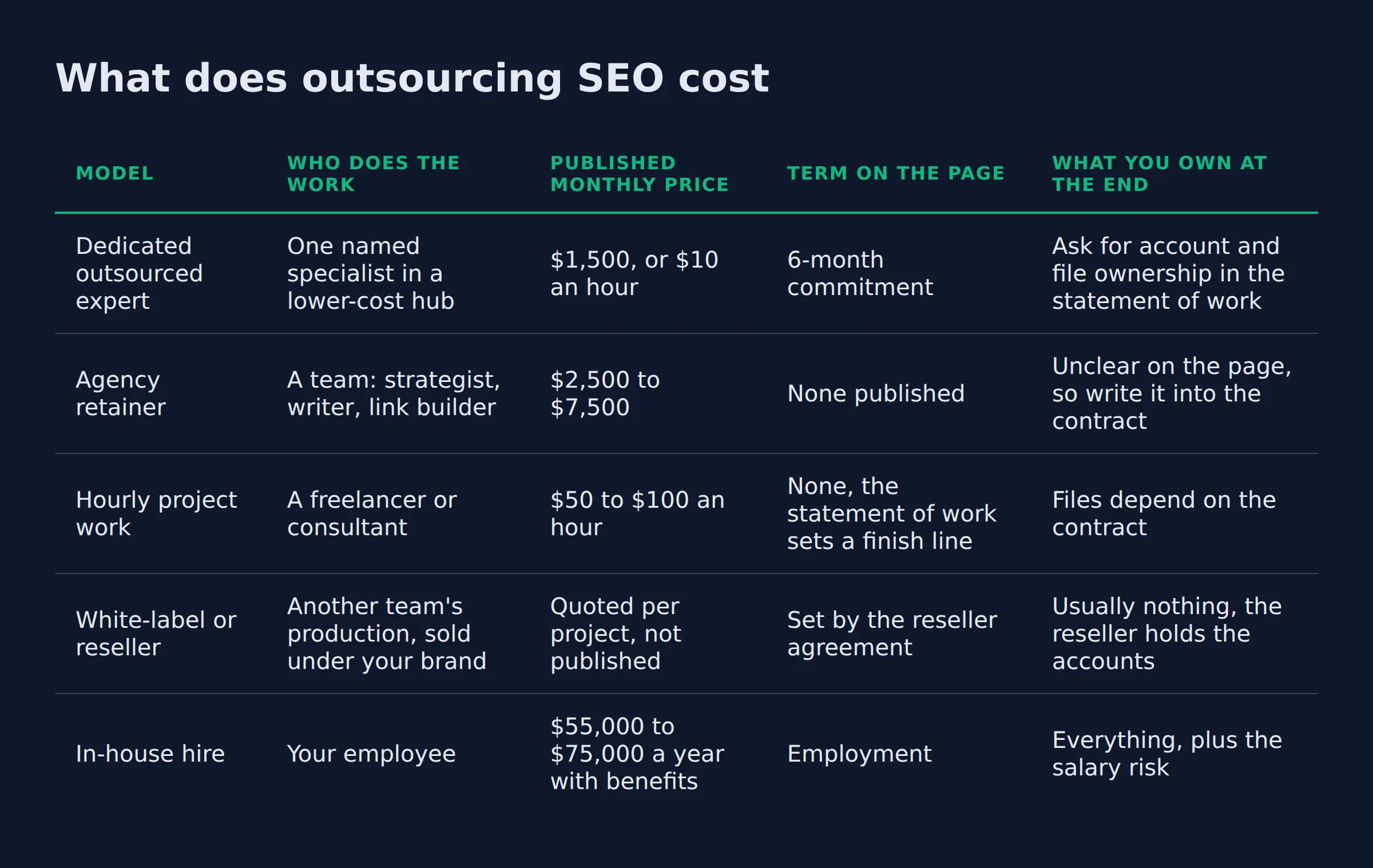
Outsourcing SEO costs $1,500 to $7,500 a month at the published rates we could check. Project work runs $50 to $100 an hour. A full-time in-house specialist costs $55,000 to $75,000 a year with benefits. That is the published range.
What does outsourcing SEO cost
Two vendors publish numbers we can verify, and they sit far apart.
SEOBoost’s dedicated outsourced SEO pricing lists a dedicated expert at $1,500 a month, with the hourly rate at $10. It compares that to $5,000+ a month in-house. The page also states a 6-month commitment.
WebFX publishes outsourced SEO cost benchmarks in a table. A retainer sits at $2,500 to $7,500 a month. Project work runs $50 to $100 an hour. Extra deliverables cost $1,000 to $5,000. The same table puts an in-house specialist at $55,000 to $75,000 a year with benefits.
| Model | Who does the work | Published monthly price | Term on the page | What you own at the end |
|---|---|---|---|---|
| Dedicated outsourced expert | One named specialist in a lower-cost hub | $1,500, or $10 an hour | 6-month commitment | Ask for account and file ownership in the statement of work |
| Agency retainer | A team: strategist, writer, link builder | $2,500 to $7,500 | None published | Unclear on the page, so write it into the contract |
| Hourly project work | A freelancer or consultant | $50 to $100 an hour | None, the statement of work sets a finish line | Files depend on the contract |
| White-label or reseller | Another team’s production, sold under your brand | Quoted per project, not published | Set by the reseller agreement | Usually nothing, the reseller holds the accounts |
| In-house hire | Your employee | $55,000 to $75,000 a year with benefits | Employment | Everything, plus the salary risk |
Those are published vendor figures, checked on 2 November 2026. SEOBoost advertises $1,500 a month, a $10 hourly rate, and a 6-month commitment. WebFX publishes no term on its table. Neither is an industry average. No survey sits behind either number.
Marketplaces sit under that range. The buyer sets the rate there. When you outsource SEO services, ask for the hours behind the quote. That count explains the price gap.
If you want the longer version of that math, we broke it down in what B2B SEO services cost per month.
The takeaway: both published anchors are one company’s price, not a market rate.
What a $500, $1,500, and $5,000 month actually buys
A month of SEO is a block of hours, and the hours set what can ship. SEOBoost advertises $10 an hour, so its $1,500 month is 150 hours of work. We price from the hour count and work back to the deliverable list. Run every quote through that lens.
| What you spend | Hours at the published $10 rate | What we would expect it to cover |
|---|---|---|
| $500 | 50 | One service page rewrite and a profile cleanup. No outreach. |
| $1,500 | 150 | Service area pages, profile work, citation cleanup, and a monthly report. |
| $5,000 | 500 | A content calendar, technical fixes, and link outreach, with a manager on top. |
The low end disappoints. At 50 hours, a vendor can fix a page set or clean a profile. Outreach does not fit in the same month.
When an owner asks what $500 a month buys, we say one page set and a profile cleanup. Outreach starts in the next tier. Anyone promising a full program at that price is spreading 50 hours across a 10-item list.
The takeaway: budget by hours, then decide which job gets them.
Which model fits: freelancer, dedicated hire, white-label, or agency?
The model decides who holds the strategy. A freelancer executes your plan. A dedicated hire works full time from a brief someone else wrote. A white-label team produces work under your brand, or your agency’s. An agency holds strategy, production and reporting. Pick by who you want making the decisions.
- Freelancer: you bring the plan, they execute. Cheapest per hour, thinnest cover when they get busy.
- Dedicated hire: fast ramp-up, because the person starts on your work. The brief is the weak point.
- White-label or reseller: the production team is invisible to your clients. Ask who signs the statement of work.
- Agency: one contract for strategy and output. The account manager you met may not be the person doing the work.
Subcontracting runs through all 4 rows. A subcontractor chain can be fine. What matters is whether the vendor will name who does the work before you sign.
Staff augmentation sits between the dedicated hire and the agency. You rent the hours. You keep the plan. It fits a business with a marketer who can direct the work.
Outsourced SEO services at the agency level usually include onboarding, a keyword map, a reporting cadence, and a monthly call. Ask what the onboarding month produces. That is where the strategy gets set, and it is the month most contracts gloss over.
The takeaway: pick the model by who you want making decisions, not by the lowest hourly rate.
How do you vet an SEO outsourcing company before you pay?
Vet a vendor on 4 questions. Who does the work by name. Who holds the accounts and the Google Business Profile. What the first 90 days change, and how calls get reported. Google’s guidance on hiring an SEO adds 2 checks: references and a read-only audit.
- Who does the work? Ask for a name and a role. A salesperson who cannot name the person on your account is selling a queue.
- Who holds the accounts? Search Console and the Business Profile stay in your name, with the vendor added as a user. Google’s questions to ask an SEO provider say to grant read access at the audit stage, not write access.
- What changes in the first 90 days? A real answer names pages. “We will optimize your site” does not.
- How do you report calls? Ask for a sample report with call counts and form fills. A keyword chart is not a report.
Google’s page lists 2 more checks. Call past clients. Ask for an audit before you sign a retainer.
Anyone selling link networks or directory blasts is describing work Google treats as useless. The same goes for submissions to thousands of search engines. Google’s spam policies name paid links and scaled thin content as ways to lose visibility. The risk lands on you. If a vendor creates deceptive content, your site takes the hit.
We ask 2 questions on a first call that most vendors cannot answer. The first is which page brought your last 10 calls. The second is what happens to the accounts if we stop working together. The first answer shows whether anyone read Search Console. The second shows whether the last vendor left anything behind. Most vendors stall.
The takeaway: references and a read-only audit cost you nothing and filter most of the bad ones.
What goes wrong when a business outsources SEO?
The failures repeat in the same order. The accounts stay in the vendor’s name, so leaving means starting over. The report shows rankings while the phone stays quiet. Blog posts ship while the profile sits untouched. Each one is fixable in the contract.
The contract failure comes first.
- A term with no exit.
- An audit file that belongs to the vendor.
- A notice period that runs past the point you decided to leave.
The reporting failure is quieter. Rankings move, calls do not, and the dashboard still looks healthy. WebFX lists vanity metrics among the 5 mistakes it warns about. It puts going too cheap and promises of fast results in the same list.
Scope creep does the rest. Blog posts are easy to produce and easy to count. The profile work takes longer, and so do the citations. Service area pages slide to next month, then out of the contract.
In our experience, terms break more outsourcing deals than talent does. In the accounts we inherit, access is the missing piece almost every time. Access comes first. An outsourced SEO program that starts with owner-level access and a 30-day exit is hard to lose money on.
The takeaway: fix ownership and exit terms before the first invoice, not after.
Is outsourcing SEO better than hiring in-house?
In-house wins when the work is steady and someone can own it full time. Outsourcing wins when you need a skill you do not have. At $55,000 to $75,000 a year for one specialist with benefits, most single-location businesses outsource first. That is the trade.
That salary is about $4,600 a month before tools. Divide $55,000 by 12. That is the number to hold against a retainer.
A hire also needs a manager, a writer, and a plan. Budget for that. One specialist without direction becomes a site maintainer.
AI search added no new checklist. Google states there are no additional requirements to appear in AI Overviews, so the fundamentals still decide it. A vendor selling “AI SEO” as a separate line item is selling the same work under a new label.
Reporting is where the comparison turns. A hire can sit next to your booking software and your GA4 setup. A vendor has to be told where the leads land, which is why conversion tracking and call tracking belong in onboarding.
If you outsource SEO and keep the logins, the downside is bounded.
If you want the reporting side in detail, how to measure local SEO ROI covers the numbers to ask for.
The takeaway: compare the salary to the retainer, then add the management time the salary hides.
What should a local service business keep in-house?
Keep the Business Profile ownership, the Search Console account and the review replies in-house. Those carry your name, and they are what you keep if a vendor leaves. A vendor can run the work. You keep the logins and the final say on what you sell.
The map pack and the organic listings below it need different work. The pack is the block that sits above the organic links on Google Maps and in search. It runs on the profile: categories, service areas, photos and reviews. The organic list runs on the website and its service area pages. Blog posts fix neither.
In our audits, the pattern is a profile that has not been touched since setup.
- The categories do not match the work.
- The service area is a radius instead of a list of towns.
- The photos are from 2 vans ago.
Those are profile fixes, and they take an afternoon. No content calendar replaces them. That is the half of the job our local SEO service runs for owners. It is why a local account needs a different scope from a national one.
The SEO services outsource decision is simpler than it looks. Keep the assets, hand over the production.
The takeaway: if the profile is half built, fix it before you buy another month of content.
The access map we use on every handover
Every handover gets the same table. We fill it in before work starts. It names who holds each asset, who can grant access, and what the vendor receives. Access starts read-only, and ownership moves only when the contract says so.
| Asset | Stays with | What the vendor gets | Why it matters |
|---|---|---|---|
| Google Business Profile | The business owner | Manager access, never ownership | A new owner can only be added by the previous one |
| Google Search Console | The business owner | Delegated or read-only access | You can check any report against the source |
| Website and hosting | The business owner | Editor or staging access, not DNS | Domain control is your protection if a contract goes wrong |
| Analytics (GA4) | The business owner | Admin granted by you | The history stays with you when a vendor leaves |
| Call tracking number | The business owner | Configuration access | The number is the lead record |
The first thing that goes wrong on a profile handover is ownership. We see listings set up under a former employee’s account. That person leaves. Nobody can add a new owner. The listing sits frozen while the phone number changes.
Google’s Business Profile guidelines allow a suspension for a profile that misrepresents the business. The risk lands on the owner. That is why owner-level access should never move.
Search Console is the same story. The free report shows how often your pages appear and which queries drive that. It also shows how often people click, per Google’s own overview. If the account sits in the vendor’s name, you lose that history the day you leave.
The takeaway: owner-level access stays with the business, every time, in writing.
FAQ
What do SEO services outsourcing reviews actually tell you?
Less than the star rating suggests. Most reviews describe communication and reporting, not results, and the vendor chooses which ones to publish. Read for specifics. A review that names deliverables and a timeline is worth more than 20 that say “great to work with”.
Are SEO outsourcing jobs and pay relevant if I am hiring a vendor, not looking for work?
No, they describe a different market. A job listing for an outsourced specialist tells you what the vendor pays the person doing your work. That is useful if you are job hunting. If you are buying, skip the salary pages and ask who does the work on your account.
Can I outsource only part of my SEO, or does it have to be all of it?
Partial is normal and usually better. A vendor can take the technical audit and the page rewrites. You keep the profile, the reviews, and the phone tracking. Split the work where your team already has coverage, and put the split in the statement of work so the edges are clear.
Who should own my Google Business Profile, Search Console, and website logins while a vendor works on them?
You should, at owner level, every time. Give the vendor manager access to the profile and delegated access to Search Console. Keep DNS and hosting control in your name. Google’s guidance says a new owner can only be added by the previous one, so a lost login can take weeks to recover.
What contract terms should I insist on before signing an SEO retainer?
Four terms, in writing. A term you can exit with 30 days notice. Account ownership that stays with you. A named person on the account. A report that shows calls and form fills. If a vendor will not put account ownership in the statement of work, that is your answer.
How long before an outsourced SEO program shows anything?
We tell owners to expect 3 to 6 months before the trend means anything. Technical fixes can show in weeks. New pages have to get indexed, then rank, then earn calls. Ask for a 90-day checkpoint in the contract so the review has a date attached.
If you want a straight read on where your visibility stands before you sign anything, a 15-minute call covers it. Bring the proposal and we will walk the scope line by line. Book it at https://link.localbizboost.com/widget/booking/lobOMW2RpbL2Vu9SblWG