Ecommerce SEO Services: What You Get and What It Costs
What ecommerce SEO services actually include, what the work costs, and how to compare providers before you sign a retainer.
Two quotes land in the same week, one at $1,200 a month and one at $4,500. Both promise more organic revenue. Neither shows what gets done in week one.
Ecommerce SEO services are a done-for-you program that helps an online store get found for the searches buyers use. The work splits 3 ways:
- Technical fixes for crawling, indexing and speed.
- Category and product copy, plus
Productstructured data. - Links that lift the whole domain.
You buy it as a monthly retainer and judge it on non-branded organic revenue.
That is the short answer. The rest of this page is the part the sales pages leave out. It covers what month one produces, what the hours buy, and the 5 checks that separate an operator from a reseller.
One line up front. Our client work runs on local service businesses, not catalogs. So the ecommerce detail here comes from Google’s own documentation, plus the audit pattern that carries across both kinds of site.
The channel is worth the effort. Ecommerce was 17.1% of US retail sales in the second quarter of 2026, per US Census retail data. It grew 12.2% year over year while total retail grew 6.7%.
TL;DR
- A full program covers 6 work areas, and 3 of them are usually missing from the pitch: feeds, variants and reporting.
- Technical order beats tool choice. Facet URLs flood an index before anything else breaks.
- US agencies average $147.93 an hour, so a $1,500 retainer buys about 10 hours of real work.
- Ask what month one produces as a countable list. A provider who cannot name that list is guessing.
What do ecommerce SEO services include?
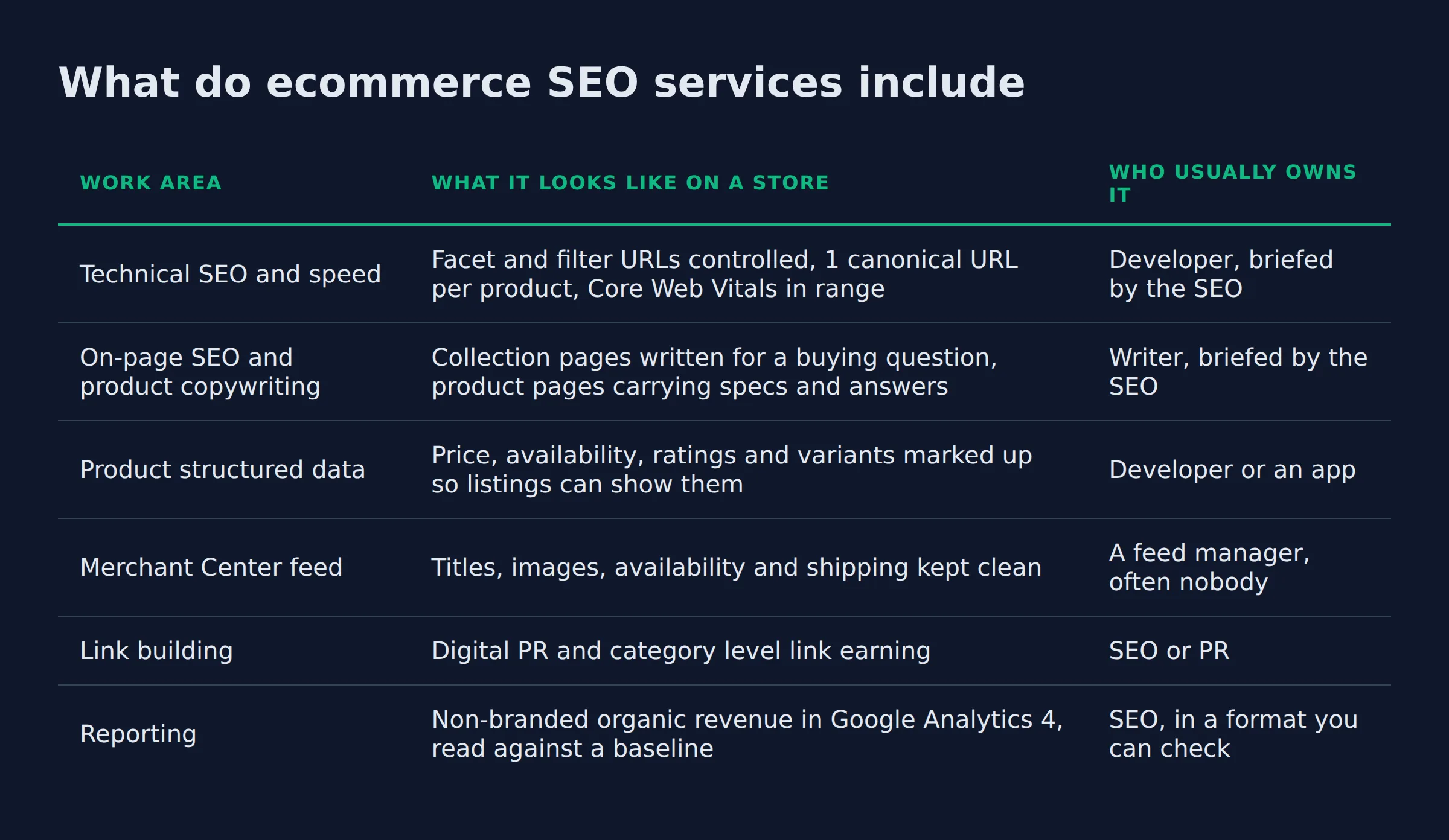
A complete program covers 6 work areas. They are technical crawling and speed, category and product copy, Product structured data, Merchant Center feeds, links, and revenue reporting. Most retainers deliver 3 of those and leave the rest to you.
Google’s own ecommerce guidance covers that same ground: URL structure, site structure, structured data and product feeds (Google’s ecommerce SEO guidance). It is the documented baseline for the work.
| Work area | What it looks like on a store | Who usually owns it |
|---|---|---|
| Technical SEO and speed | Facet and filter URLs controlled, 1 canonical URL per product, Core Web Vitals in range | Developer, briefed by the SEO |
| On-page SEO and product copywriting | Collection pages written for a buying question, product pages carrying specs and answers | Writer, briefed by the SEO |
Product structured data |
Price, availability, ratings and variants marked up so listings can show them | Developer or an app |
| Merchant Center feed | Titles, images, availability and shipping kept clean | A feed manager, often nobody |
| Link building | Digital PR and category level link earning | SEO or PR |
| Reporting | Non-branded organic revenue in Google Analytics 4, read against a baseline | SEO, in a format you can check |
The copy work starts with keyword research at the collection level. That is where a buyer searches, and internal linking runs from there down to the products.
The table then sets what a quote should cover. A retainer covering 3 rows and a monthly report leaves the feed work out. The feed is what decides whether a product shows up in Shopping surfaces, free listings included.
If you want a one page version, an e commerce seo checklist writes itself from that table. One line per work area, plus the name of who owns it.
Marketplace listings are separate work. A clean feed for your own store does nothing for your Amazon, Walmart or Etsy listings.
Category pages are where the copy work fails quietly. A collection page filled with template copy and no buying guidance is a thin page, and scale makes it worse.
Google’s spam policy calls scaled page generation for rankings “scaled content abuse” (Google’s spam policies), and we cover the pattern in thin content versus real landing pages.
A quote that names 3 work areas is a partial program, whatever the monthly number says.
Which technical fixes come first on an online store?
Order the work by revenue risk. Control the facet and filter URLs that flood the index. Then settle 1 URL per product and per variant, and make pagination crawlable. Speed and markup come last, and the first 2 fixes protect the pages you already hold.
Google’s faceted navigation guidance is blunt about why that comes first. Parameter based facets can create “infinite URL spaces”, and those spaces harm the site (faceted navigation crawl control). That is index bloat. Control usually ships as robots.txt rules and a canonical on the clean URL.
From there the order holds:
- Duplicate and variant URLs. Google consolidates near copies with a
rel="canonical"signal (duplicate URL consolidation). Variant products get grouping markup too, usingProductGroupwithhasVariantandvariesBy(product variant markup). - Pagination. Google says each page in a paginated set needs its own URL, and that it sees “the most URL mistakes in pagination URL structures” (ecommerce URL structure). Load more buttons and infinite scroll need real links behind them (pagination and incremental loading).
- Speed. 3 Core Web Vitals metrics decide the pass mark on a product page (Core Web Vitals thresholds):
- Largest Contentful Paint: 2.5 seconds or less.
- Interaction to Next Paint: 200 milliseconds or less.
- Cumulative Layout Shift: 0.1 or less.
- Structured data.
Productmarkup in schema.org, with anOfferfor price and availability plusAggregateRatingfor reviews, lets Google show both in results (product structured data).
The habit we bring from local audits is a count. Pull the URL count from the XML sitemap, then the indexed count from Google Search Console. When those numbers disagree by a wide margin, nobody wrote the extra pages. A pattern generated them.
On the service sites we audit, the extra URLs come from tag archives and location variants. Run the same count on a store and the filter parameters add the bloat faster. The question that settles it is how many of the indexed URLs a customer can actually buy from.
Fix the URL pattern before any product page, because a product page competing with its own filter copies cannot win.
What the first 30 days should hand you
Month one should end with an inventory and a ranked fix list. Traffic comes later. Once the fixed pages have held a position, revenue follows.
We call that inventory the output list. Ask for it as a document you can count, and ask for the same list dated at the end of every month. It has 6 items:
- A URL count by type, covering product, collection, facet and internal search pages.
- One written decision on the canonical pattern for products and variants.
- A crawl with redirect chains and error counts.
- A Merchant Center feed audit listing disapprovals and missing attributes.
- A dev ticket list, ranked by revenue risk.
- A baseline of organic sessions and revenue in GA4 with brand terms filtered out.
The hardest pushback we get is on paying monthly for work nobody can see. What settles it is that dated list, with last month beside it. A count wins the argument.
Ask for that list dated at the end of every month, then read the next one against it.
How is Shopify SEO different from WooCommerce SEO?
The difference is control. Shopify fixes the URL and checkout structure and gives you collections, metafields, theme templates and apps to work with. WooCommerce hands you the whole stack, so more dev hours land on your side of the table.
Google’s URL guidance tells platform users they can likely skip its URL section (ecommerce URL structure). The platform already handles the patterns.
| Platform | What you can change | What fights you | Effect on the retainer |
|---|---|---|---|
| Shopify | Collections, metafields, templates, apps, redirects | Fixed product URLs, locked checkout | Fewer dev hours, more app fees |
| WooCommerce | URLs, templates, markup output, the server | Plugin conflicts, speed work sits on you | More dev hours, speed is the main spend |
| Magento (Adobe Commerce) | Everything, at a cost | Slow release cycles, enterprise complexity | Highest hours, needs a dev on the call |
| BigCommerce | Templates, facets, feeds | Fewer apps than Shopify | Middle of the range |
| Salesforce Commerce Cloud | Everything, with a partner | Enterprise staffing, slow change control | Hours depend on the partner doing the work |
| Wix, Squarespace | Templates, page copy, some markup | Hosted, so speed and crawl work is capped | Copy and feeds only |
Quotes follow that table. A shopify seo services quote and a woocommerce seo services quote for one catalog rarely land in the same place.
On Shopify the hours go to copy and feeds, because the platform handled the plumbing. On WooCommerce the plumbing sits on the owner’s side, and speed work alone can fill a month of anybody’s hours.
Budget the hours to match what the platform leaves undone, then compare the totals.
What do ecommerce SEO services cost?
Market rates sit near $150 an hour. Half of SEO providers charge under $3,000 a month, so most retainers buy a fixed block of hours rather than a fixed result.
A survey of close to 400 providers puts US agencies at $147.93 an hour and US consultants at $144.68 (Semrush’s SEO pricing survey). That band holds whether you hire a shop or one person.
The table below is market illustration, not our rate card. It shows what the cited hourly rate buys on a store under 1,000 SKUs.
| Monthly fee | Hours at $147.93 | What it buys on a store under 1,000 SKUs | What to check |
|---|---|---|---|
| $1,000 | about 7 | Copy on a handful of collections | Whether dev work is included at all |
| $1,500 | about 10 | 2 or 3 collection rewrites plus fixes | Whether feeds are in scope |
| $3,000 | about 20 | Template and markup work, copy, a feed pass | A named dev contact |
| $5,000 | about 34 | All 6 areas, monthly, with room for a migration | A written output list |
| $10,000 | about 68 | Several locales or a catalog in the thousands | A team, not one freelancer |
Convert 2 competing quotes into hours and the cheaper one usually stops looking cheaper. The hours column is arithmetic on the cited rate. The scope column is what that many hours looks like in outputs.
Scope you can count is what pushes the fee up:
- SKU count.
- Filter depth.
- Locales.
A migration adds hours, and so does a catalog with weak images. Locales multiply the work. One store with 3 locales runs the same template 3 times, and each localized page needs its siblings declared through hreflang (localized versions).
A second survey lands in the same band, with an average retainer at $2,500 a month (WebFX’s SEO pricing survey). Most businesses sit between $1,000 and $5,000.
Now the low quotes. A professional seo services quote under the market usually leaves out 1 of 3 things:
- Dev hours. Quoted as extra later.
- Copy. Written from a template or by a junior.
- Feed work. Not mentioned at all.
Convert every quote to hours, because the monthly number hides the rate behind it.
AI search, and what it adds to the scope
AI search adds no new technical requirement. Google says so in its own guidance: there are no extra requirements to appear in AI Overviews or AI Mode. What changes is the standard on the boring parts.
Google’s guidance on AI features spells out that position, and the usual SEO practices still apply there too. The boring parts are the ones carrying facts.
Product data reaches Google through a Merchant Center feed and through markup on the page (product data feeds). Image quality, attributes, and a straight answer in the first line of a collection page are what those systems read.
That is also why an AEO line item deserves its own question in a pitch. A lot of AEO work is the markup and copy work above, renamed. Conversion rate optimization and content strategy sit close by, and both are easier to prove with a before and an after.
Ask what an AEO line item adds that clean markup and real product answers do not already cover.
How do you choose an ecommerce SEO company?
Five checks settle it before you sign. Ask who does the work and what month one produces. Then ask what access is needed and how organic revenue gets reported. The last check is what they refuse to promise.
- Who does the work. Get the name of the person who will edit templates. A senior team is not a name.
- What month one produces. You want the output list from earlier, dated.
- What access they need. Search Console, GA4, Merchant Center and a staging copy of the store. Admin on production on day one is a risk.
- How they report revenue. Organic sessions and revenue in GA4 with brand terms filtered out, next to a baseline. A rankings screenshot is not a report.
- What they refuse to promise. Google’s hiring guidance says to find someone else if a provider guarantees first place (Google’s advice on hiring an SEO).
A list of the best seo services companies is a place to collect names. The order on the page is not a measure of fit for a store your size. Directory reviews describe the agency’s profile. The work on your templates is a separate question, and the 5 checks cover it.
Ask for the name of the person doing the work, because that is the hardest part of a pitch to fake.
When the store also serves a metro
A store with a shopfront, pickup or a service area needs the local side handled on its own. The Google Business Profile and the store carry the same facts. They drift apart on hours first, then on availability, then on the address customers see.
We see this on service sites that add a product line. Hours break first. Pickup settings follow, because 2 people edit 2 systems and neither one owns both.
Google keeps local results on relevance, distance and prominence (how Google ranks local businesses). None of that comes from a product feed. That local side is what our local SEO service covers, and it runs on the same fix list.
Keep 1 calendar and 1 set of hours for both systems, or the store will tell customers something the listing contradicts.
FAQ
Is SEO good for ecommerce?
Yes. A store’s non-branded traffic has to come from category and product pages. Those pages need crawl fixes, real copy and markup. A store also carries feed and variant problems that a brochure site never meets.
What is an ecommerce SEO service?
A monthly service that runs the search work on your store. It fixes crawling and speed, and writes category and product copy. It also adds product markup, cleans the Merchant Center feed, earns links and reports organic revenue.
Is SEO dead or evolving in 2026?
Evolving. Google says AI features carry no extra requirements, so the basics still decide who gets shown. What moved is where the answer sits, since a summary can appear above your link. Clean product data is what gets a store into those answers.
What does “SEO services” mean?
The work a provider does to help a site get found in search. On a store that covers technical fixes, page copy, product markup, feeds, links and reporting. The label spans a solo freelancer and a national agency, so the price spread is real.
How do I compare an ecommerce SEO services list or a set of reviews without getting played by the ranking order?
Collect names from the list, then ignore the order. Run the 5 checks on each provider and ask for the hours behind the price. Directory reviews describe the agency’s profile, and your templates are a separate test.
How long before organic revenue moves, and what should be visible in month one versus month six?
Month one is the inventory and the ranked fix list. Expect impressions to move before revenue does. Revenue follows once the fixed pages have held a position for a while. A provider who dates a revenue number is guessing.
If you want a straight read on where your visibility stands, the store or the listing, a 15-minute call covers it. We open both with you and point at the gaps. Book a 15-minute call.